We’re Experiencing The Most Top-Heavy Championship Since 2011

It looks to me like we are having an unusual year of two strong title contenders followed by a big drop off. The gap between first and second place in the championship is 28 points with two races remaining. Kanaan is 113 points away from the leader in third place.
To see if this is actually unusual or simply the norm, I went back to all seasons 2009 and on and checked how many points per race the top two contenders were averaging together with two races remaining. I adjusted to account for double points races by making them count for two races. 
Here’s what I found:
Power and Pagenaud are averaging 68.7 points per race together this year, the most by any championship-leading duo since 2011. These two drivers are running away with the championship and are the strongest in the field by a wide margin. You have to go back to the 2011 season led by Franchitti and Power to find a stronger pair of leaders. The two years preceding 2011 were also particularly strong, perhaps a sign of IndyCar increasingly becoming more competitive in recent years?
So what exactly does this mean for the championship? For one it means that whoever wins the championship out of Power and Pagenaud will be a worthy recipient. Both of these drivers blitzed the field this year with four wins a piece as of writing. The last time multiple drivers won four or more races in a season was (you may have guessed) 2011.
Power will need to try and improve on his personal PPR (currently at 33.4) and get another race win — preferably at the double points Sonoma finale — or bank on a poor race from Pagenaud if he wants to snatch the title from his teammate.
by Drew
Long Beach Win Probability: Pre-Race

Here’s the pre-race win probability for the top five qualifiers at Long Beach. The race gets started a little after 4 p.m. today.

I’ll be tweeting out live win probability updates throughout the race, so be sure to follow me on Twitter @thesingleseater. You can also read about how win probability (also called win expectancy) works here.

by Drew
//platform.twitter.com/widgets.js

How Fast The New Track Record at Long Beach Will Be

There have been two races so far this season, and two lap records have been set. Power ran a 1:00.2450 and claimed the lap record at St. Petersburg, and Castroneves put in a 19.0997 second lap at Phoenix, besting the previous record.

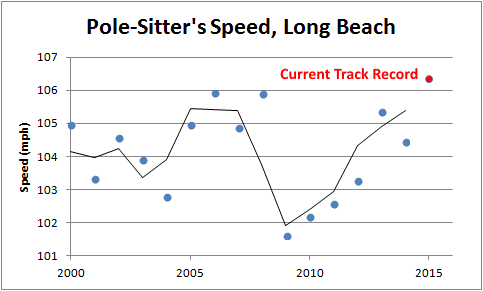
I wouldn’t be surprised to see another lap record fall this week at Long Beach. Here’s a look at the pole-sitter’s speed through the years — qualifying is usually where the track record is broken.

Dixon bested the previous record by 0.4 mph last year, and I would bet that the record will be beat again this year by an even greater margin. (The new track record at St. Petersburg beat the old by 0.8 mph.)

Expect the new track record to be between 106.9-107.2 mph.

As to who will set that record? My money’s on Castroneves or Power, two of the best qualifiers in the field.

by Drew 

A Note About Win Expectancy Early on in the Race

If you haven’t read about it already, I’ve made a win expectancy tracker for IndyCar. Something interesting I came across while developing it…

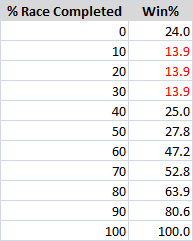
Below is the win expectancy for the driver in first place at different stages of the race.

You’ll notice that the win expectancy actually drops off from the initial 24 percent during the 10-30 percent of the race completed stages. Why would the driver in first be less likely to win the race when 10 percent of the race is completed than when he started on pole (and thus had more of the race left to complete)?

First, I think that the beginning of the race is pretty chaotic and a lot of overtaking happens, so it’s pretty easy for the guy who started on pole to get overtaken.

And second (and more likely), if a driver started on pole and knows he has a competitive car, he may not be too worried about leading right away. He’ll let the aggressive guy in second place overtake him and then just focus on strategy, conserving fuel and tires, etc. Just preparing for the second half of the race where things start to matter more.

If you have any more ideas on it let me know in the comments.

by Drew

Tracking Live Win Expectancy

I’ve been working on a win expectancy tracker for IndyCar similar to the one FanGraphs uses for baseball. Based on the driver’s current position and how much of the race is completed, it calculates the percent chance he will win the race — using historical data from the 2013-2016 seasons.

It works by finding the win percentage of drivers who were in similar situations in the past. For example, if a driver is running in second place with 60 percent of the race completed, he has a 13.9 percent chance of winning the race. That’s based on five drivers in the database (36 races as of writing) being in second place with 60 percent of the race completed going on to win the race.

If a driver has a 23 percent chance of winning, that means 23 percent of drivers in the same situation went on to win the race.

Besides telling how likely each driver is to win the race, it’s also beneficial to see which drivers need to make big strategy moves to have a shot at winning. If a driver only has a 13 percent chance of winning, maybe he’ll want to go off strategy and hope to get lucky with a caution. Win expectancy is also interesting to look back at after the race to see when the big moments of the race were.

It’s important to note that win expectancy doesn’t care about who the drivers are, the prevalence of cautions at certain tracks, or anything else of that nature. So it’s a bit of an oversimplification, but a useful one nonetheless. It reports the long term averages for running position and the amount of the race completed.

Road/street course results are separate from oval results, but so far only the former is done.

I’ll be tweeting out live win probabilities during races and also including them on the site.

by Drew