Is Williams Finally Regaining Their Old Success?

Williams drivers Valtteri Bottas and Felipe Massa in front of the 2014 Williams F1 car.  Source: motorsportchannel.com

Back in the 70’s, 80’s and 90’s, Williams Formula 1 team was a powerhouse of the sport. Their drivers included Keke Rosberg, Nigel Mansell, Nelson Piquet, Michael Schumacher and Aryton Senna.  They had tremendous success with these drivers, bringing home multiple driver’s and constructor’s World Championships.   But in the last couple of years, Williams has been at an all time low, finishing 9th, 8th and 9th again the last three years in the Constructor’s Championship.  


But this year has been different.  Williams seems to be regaining their game after the addition of Felipe Massa to their team and keeping Valtteri Bottas.  Ten races into the season, Williams is third in the Constructor’s Championship (just ahead of Ferrari) and Bottas is fifth in the driver’s side of things, with no sign of slowing down (Figure 1).  At the German Grand Prix this year Bottas started second and Massa third, a tremendous qualifying result for the team.

So what’s making them so strong?  To start, they have a strong and experienced Massa paired with 24 year old Bottas, and they are both performing at a very high level.  

Bottas has been on the podium three times and has an average finish so far of 6.3.  This is far better than last years stats of no podiums and a 14.4 finish.  If Valtteri Bottas continues his form through the rest of the season, he could definitely see a new contract offer from another team.  Bottas is all set to keep improving in the coming seasons, with his points going from 4 in 2013 thorough all 19 races to 91 this season through just 10.  Bottas’ success this season is a huge part of the Williams team great success so far.  

The other half of the team is governed bye ex-Ferrari driver and 11 time winner Felipe Massa.  He is the veteran of the team with 12 years of F1 experience under his belt. Although he was never a world champion, Massa has been crazy consistent in a Formula 1 car.  His average start and average finish are 8.4 and 12.8, respectively.  It is very valuable for Williams and in particular Bottas to have an experienced driver to help with getting the car set up.  

Figure 1


Williams as a team has had it’s fair share of retirements, (4) but only on three other occasions have one of their drivers finished outside of the top ten.  This is a testament to the drivers and teams consistency.  They haven’t been good on just one track but have performed well on all of the circuits.  These types of results are what put Williams in the Constructor’s Championship running.  I don’t think they have the car or driver (yet) to win a Driver’s World Championship, but they certainly are moving in the right direction.  

If Williams can continue to improve the reliability and speed of the car, as well as continue to get young talent like Bottas on the team, they are looking as if they can regain their success of the past in the coming years.  As for the rest of the season, we’ll have to see if either Bottas or Massa can get a win and truly put Williams back on top.  

          – Drew Bennison

Should Race 2 at Toronto Be Started Using Road Course Points?

The scene at yesterday’s Toronto race, in Toronto, Canada.
Source:  Oregon Herald


Race 2 of Toronto later today is going to be started based on drivers points after the first race.  So in other words, whichever driver leads the championship after race one (Helio Castroneves) will start on pole.  No qualifying will happen because of both races being moved to Sunday.  But that begs the question, if they want the best drivers at the front, why not set the grid based on road course points?  


If you didn’t know, IndyCar keeps track of road course points for each year. They also do one for ovals and these competitions are separate from the overall championship leader.  This is meant to provide another competition to drivers, but it seems they aren’t using these points to their full advantage.


This would be a seemingly easy fix to the problem drivers have that only run road courses (Mike Conway).  Conway is 23rd in the Championship standings because he hasn’t raced in four of the races the other guys have.  Now you may be thinking four races isn’t much, but there are possible 216 points up for grabs over the course of these four races, and even more as we’ll see.  To put that in perspective, positions 1-15 of the driver’s championship are separated by just 227 points. These points are very valuable and can be the difference between a championship win or not. His team knows this too and expressed their confusion earlier this morning (below).

//platform.twitter.com/widgets.js
If we take a look at Conway in the road course standings, he jumps up to 16th, a 7 place difference.  Even though it’s not a last to first place jump, at least the grid positions would be fair to all drivers and not punish those who choose not to run the ovals.  The points are all readily available to IndyCar, so when qualifying can’t be completed, why punish some of the drivers? 

Note: To “make up” for Conway’s significantly less points they are adding Ed Carpenter’s points to his and basing the grid position off of their combined totals. 

Going in to the standings, we see the difference in position wouldn’t only come to Conway, most of the drivers would gain or lose positions:

Justin Wilson is 14th in the championship, not a great starting position on a tough track like Toronto.  But as we look at the road course standings Wilson moves up to P8, a significant advantage in the race.  This is a case where using road course points would benefit a driver.  

Some drivers won’t be so lucky, 6th place in the championship driver Carlos Munoz would be back down in 18th.  A killer 12 place grid drop would definitely change his race strategy, and chance at a championship.  But if he isn’t good on street courses, he shouldn’t start up top with the better drivers.  

Another note about the oval courses that favors the drivers who do well in them: double points in 500 mile races.  In the Indianapolis and Pocono races double points were awarded. Conway had no chance to get points in those races and now there is a bonus for those who do. No road course or street track offers double points, it is making the grid for today’s second race in-accurate to the intentions of IndyCar.  

Setting the grid based on road course points is a way to even up the situation when qualifying just can’t happen.  The way IndyCar will set up the grid today is meant to put the best drivers at the front, but the data shows that the drivers starting up front aren’t all really the best.  Starting with road course points is the only way to get accurate and fair grid positions set for all drivers. 


 – Drew Bennison

Check out this link to see where your driver would end up if IndyCar started Toronto Race 2 using the road course standings.

Double Header In Toronto: Race Notes

 #9 Scott Dixon of the Ganassi Racing team at the driver’s introduction ceremony.

The Verizon IndyCar series will be visiting Toronto later today and tomorrow for the second year of double-header racing in Canada.  The first race will be held today after qualifying and then a repeat of the exact same race follows tomorrow (The drivers re-qualify tomorrow morning.)  The last two double-headers this year saw no repeat winners, with Power, Castroneves, Huertas and Pagenaud all taking home wins.  

This Year
Scott Dixon driving for Chip Ganassi brought home a victory in both of the Toronto races last year (And is the only driver to win both back-to-back races).  If he were to do the same again this year, he could see at least 100 points coming his way and a major boost in the championship standings.  Depending on his qualifying position, he could see extra points for the P1 Award as well.  Both Dixon and his new teammate Tony Kanaan will be looking for lots of points to catch up this weekend to get in contention for the championship with just 4 races to go after this.   

Cautions have been notoriously quick and scarce at Toronto, just 3 in the last race here.  This year, expect green flag pit-stops and very, very short cautions yet again.  Throughout both races last year, only 24 laps were run under caution out of the combined total of 190.  That comes out to be 12.6% of the race.  If the cautions don’t come out at just the right time, teams will have to change their strategy or risk pitting under green (Lap times are only around 58 seconds).  With less and less cautions each year, the average speed has been building up over the past few years as well.  In 2011, the average speed over the course of the race was 76.805 mph, last year we were up to 94.177.  This shows that both the cars are getting faster, as well as less cautions are being thrown.  
The Points
The three double headers on the calendar this year mean a lot of points and ground can be made up on the current leader of the championship, Helio Castroneves.  The top 5 drivers in the points are only separated by 66 points, and a win or two from any of them could send them into first place.  Castroneves has been strong in Toronto in the past, coming in 6th and 2nd place in race 1 and 2, respectively.  If he doesn’t give another strong showing this weekend, his lead could be in jeopardy.  Over the last couple races, Castroneves has been all over the place, with a DNF, 2nd place and eight place finish.  He’ll have to tighten up if he hopes to bring home the championship at Fontana.  

Rain Note:  – 4:33pm – 7/19
The rain delay and red flag brings up some interesting changes to the race.  First off, the drivers will be sitting on the grid for a significant amount of time.  They have to be ready once the green flag drops again.  They were all ready for the green flag after the three or so warm up laps and now they have to calm done and get ready again.

Second, the race will no longer have a standing start because of all the standing water that will be on the track.  It will be a single file rolling restart which again brings a mental change that the drivers need to make.  

The rule for IndyCar is a two hour race limit if the regular number of laps can’t be completed (85 in this case).  It looks like the Toronto race will fall under that two hour category if this rain continues.  

The drivers need to get calmed down and get ready for the green flag to drop within the next ten minutes here in Toronto.  Especially since the points race is so close going into this weekend.  

Tire Note: – 4:51pm – 7/19
Firestone is using the same rain tires throughout all the street tracks this year.  There was rain in Houston as well, and the tires performed very good.  But, Toronto has significantly less track grip than Houston did, with less grip on the cement parts of the track.  

Standing water is also going to be a problem on the track with the rain still coming down as the warm-up laps continue.  Expect some spins and a very cautious race from all drivers out on the track.  


          -Drew Bennison

German Grand Prix: Race Notes

                        The start of the 2013 German Grand Prix. Source: f1fanatic

With the German Grand Prix this weekend, Sebastien Vettel and Nico Rosberg will be among the four German drivers in the field looking for a good result on home turf.  The Mercedes team should continue it’s dominance barring any reliability issues like we saw in the British Grand Prix last week.  


Vettel

Unfortunately for them, the numbers aren’t looking so good for Germans at the Hockenheim circuit.  

Fernando Alonso has taken home the victory the last two times Formula 1 has visited Hockenheim, both in 2011 and 2012.  Vettel did, however, win at the Nurburgring last year with his dominant Red Bull, but the 2014 season has been a lot rougher than Vettel expected after topping off his fourth consecutive World Championship last year.  Sebastien has managed just 70 points through almost half of the season and only gotten on the podium twice.  At this point in the season last year, Vettel already had four wins under his belt.  If Red Bull and Sebastien Vettel want a strong second half of this season, Hockenheim is the place to turn it around.

Mercedes

The constant team battle within the Mercedes between Nico Rosberg and Lewis Hamilton is sure to prevail again in Germany, that is is Lewis Hamilton can make it back up through the field.  Nico will be eager to get a win in front of a home crowd while Hamilton will try to catch and take over Rosberg and overcome the four point deficit he is in. Lewis Hamilton is the only one of the pair that has gotten a win in Germany, back in 2008.  It is rather unlikely that by the time Hamilton makes it up to the front Rosberg will still be there, so he will have a tough task Sunday.

The Driver’s Championship leader has been switching race by race between these two, with just four points between them going into this weekend’s Grand Prix. The closest competitor is Red Bull’s Daniel Ricciardo, a whopping 67 points behind Hamilton. In the Constructor’s Championship, there is even less of a threat to the silver arrows. Mercedes is in first with 326 points, followed by Red Bull with just 168 – a 158 point lead.  As long as Mercedes doesn’t start suffering technical issues with the cars, their chances to take home both Championships are looking safe.  
Expect an all out race from Rosberg as he tries to distance himself from Hamilton, and keep an eye out for Kimi Raikkonen and Daniel Ricciardo, when the lights go out this Sunday.
           – Drew Bennison

Key points of the Hockenheim circuit.

When Are IndyCar Drivers In Their Prime?

Tony Kanaan after his Indianapolis 500 win in 2013. Source: USA Today

Racing has long been a sport for people of all ages.  For example, Mario Andretti won the Phoenix Grand Prix in 1993, making him 53 at the time, and the oldest person to ever win an IndyCar race.  This wasn’t his last year in racing either, Mario went on to Formula 1 in the next season, arguably (but it’s really hard to), the top racing series in the world.  And yet we have people such as Josele Garza who are racing in the Indianapolis 500 at just 19 years old. So that begs the question, at what age do Indy Car drivers actually peak?  More specifically we’ll be taking a look at Tony Kanaan after his outstanding performance in the Iowa 300 this week and his Indianapolis 500 win last year, to see his peak years.   


We are going to be using Tony Kanaan’s career results as our data points for a number of reasons.

          1) Tony Kanaan is still an active driver and provides recent data
          2) He is an old enough driver (39) to have gone through his peak years
          3) He is an actively competitive driver in the races
          4) Kanaan has endured a long career which gives us a lot of numbers to work with

Note: Obviously, the final age isn’t going to be perfect for all drivers because of a number of factors.  There are going to be drivers that are different and achieve success at a very young age and yet some that have their best years towards their end of their career.  This is meant to be a generalization of when to expect the best performance out of a driver, as well as give us a good understanding of when Kanaan peaked.  

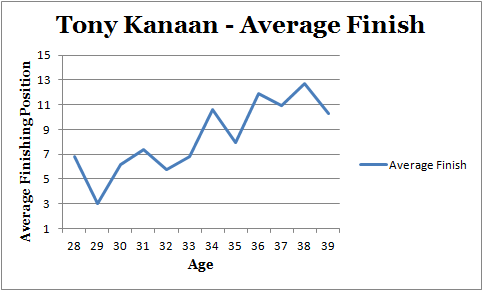
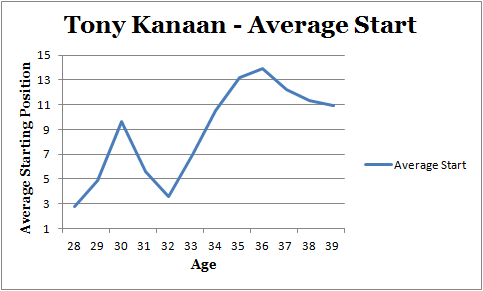
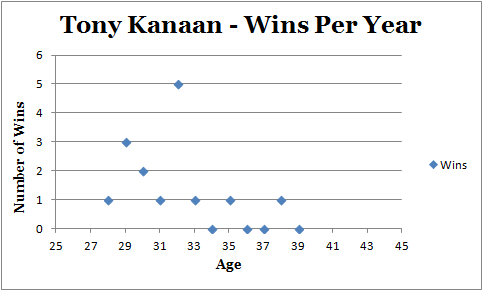
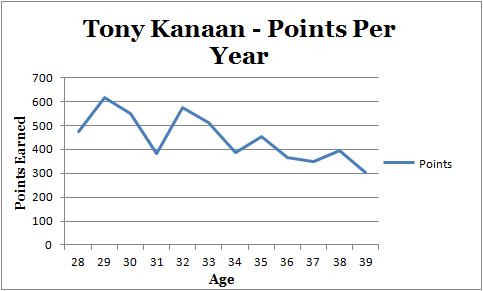
We will be comparing the top three statistics of Kanaan over the course of the last 12 years he has been in the IndyCar series.  The only season we are excluding his 2002 season is because he only ran one race.  We’ll check out the number of wins, average start position, average finish position, and points earned for each year:  


If we take a look at the age where he was most proficient in each category, we get age 29 for average finish, 32 for average start, 29 for points per season, and age 32 for most wins in a season (5).  This model doesn’t take into account the number of races run each season but since they only differed by 2 races for the bulk of Kanaan’s time it is still accurate.  Now based on this data, we could say Tony Kanaan had most of his success at age 30.5 in his career.  But, this would be an average of just the four statistics we looked at.  


His most successful age is really up to interpretation, whether you say that it’s the season he had his most wins, points or if you choose to think that all of his stats combined and averaged gives us his best season.  The problem that arises when you try and put all sorts of stats together is in how you choose to weigh the different pieces of data.  Maybe poles and wins are more important than average finish to you, it all depends.  

According to our weighted model, TK was in his prime at around age 29.5.  This is when he had is overall best season and finished with 3 wins, 11 podiums, and finished first in the driver’s championship with 618 points.  If we want to try and apply this to all drivers, we can give the model a +/- 3 years lenience to determine the “prime” years of said driver.

As for Tony Kanaan, it seems he has left his best years behind.  Sure, he’ll still be putting up good results every once in a while and maybe even a few wins, but he won’t be nearly as consistently competitive as in his early thirties. 
         
               – Drew Bennison