Lotus Is Switching To Mercedes Power At The Right Time

On Friday, Romain Grosjean said that he believes the 2015 season “will be very much about reminding people how good Lotus F1 Team and Romain Grosjean can be.” This comes after a disastrous previous season that saw Lotus only pick up ten points in the constructor’s championship.

Lotus should have a much stronger outing in 2015 after switching to Mercedes power.    — Photo: Lotus F1 Team

Over the off-season, the team switched from Renault to Mercedes power and are hoping it will give them an edge in the upcoming season. After successful test sessions in Jerez and Catalunya, the team should be feeling more confident than they were heading into the Australian grand Prix last year.

And rightfully so, too. With Mercedes now powering the car, Lotus should be much more competitive than they were last year when their highest finish was eighth place. Four of the top six constructors ran with Mercedes power, including the champions Mercedes AMG Petronas. Ferrari and Renault power claimed the other two positions. Three of the top six drivers in the points standings were also behind Mercedes-powered machines.

Besides Ricciardo, Vettel, and Alonso, all of the drivers in the top twelve positions in the points standings were running Mercedes power. Obviously, even with the engine switch, it isn’t guaranteed that Lotus will be able to beat out these other teams. Driver skill plays the biggest role in securing good finishes, but being closer to the fight will certainly help out.

Grosjean acknowledged that “we still have work to do and our car’s not perfect” for 2015, but it’s better than what they had going into last season. If the team can avoid just a few of the eleven technical failures they experienced last season, there’s no reason they can’t be fighting for points paying finishes every race.


Which IndyCar Driver Takes the Twitter Checkered Flag?

A look at which Verizon IndyCar series drivers have the most followers on Twitter. — Photo: NY Post

Drivers, start your fingers!

Twitter has become the primary source for all sorts of people to connect with each other. With 140 characters, you can send out your thoughts in an instant along with pictures, videos, and links to websites or anything, really.

This means of communication has become especially powerful for celebrities and athletes, including IndyCar drivers. The ability to respond to others’ tweets is easy and fast, connecting the fan and driver together. But which IndyCar driver is harnessing this power the best? We took a look at current IndyCar drivers and their Twitter profiles to see who is getting the most following on Twitter.  

—–
The bottom of this article contains a full table of IndyCar drivers and their followers.
—–

To start, it’s worth noting that even the most followed IndyCar driver comes no where close to the most followed Formula One driver. That title goes to Lewis Hamilton, the 2014 World Champion, who has over 2.6 million followers on Twitter. Following closely behind him is McLaren driver Fernando Alonso, who has over 2.2 million followers. In comparison, the highest followed IndyCar driver has around 2 million less followers.

But these numbers aren’t really surprising. After all, Formula One is a truly world wide sport, has been around longer, and has a larger following than IndyCar. Sure, IndyCar does venture outside the States sometimes, but not nearly on the same scale that F1 does. The 2015 F1 calendar is set to travel to 20 different countries this season; IndyCar is scheduled for races in the United States and Canada only.

Narrowing our field down to just IndyCar drivers, and we see a wide gap in the follower count between drivers. This is due to a number of factors, namely popularity and how active the driver is on social media. 

Only four drivers have over 100,000 followers on Twitter, and the top two drivers have more followers than all of the other drivers combined. These numbers are tiny compared to the F1 world. 

Some notables include Ryan Hunter-Reay, 2014 Indy 500 winner, who comes in with 54,100 followers. James Hinchcliffe, who is very active on Twitter with over 11,000 tweets, has 56,500 followers. Marco Andretti sits at 81,900 and Graham Rahal is at 66,000 followers.

And now we get to Will Power, 2014 IndyCar series Champion. He must have a big following, right?

Wrong. The Aussie has amassed just 61,200 followers during his time on Twitter.

Now we get to the big four, the top IndyCar drivers with the most followers on Twitter. 

In fourth, Helio Castroneves with 127,000 followers since opening his account in 2009. Dario Franchitti, although not an active driver anymore1, comes in at third with 136,000 followers on his account. 

At the number two spot is Tony Kanaan. TK has been racing in the series and using Twitter for a long time. Since joining in 2009, he has gained over 628,000 followers on the site.

And the number one most followed driver on Twitter? Juan Pablo Montoya. Montoya beats out Kanaan by nearly 300,000 followers and has over 8,000 tweets sent. His popularity can be attributed to his many years racing and the different series he competed in. Montoya has driven in Formula One, NASCAR, and IndyCar throughout his career, gaining fans (and followers) from each series.


It’s clear IndyCar drivers just don’t have the same following as Formula One drivers do, but some of them are making significant inroads on the problem. 

You can view the entire list of the drivers and their Twitter followers below. And if you’re interested in keeping up with Single Seater, you can follow us on Twitter here

table.tableizer-table { border: 1px solid #CCC; font-family: Georgia, serif; font-size: 16px; } .tableizer-table td { padding: 7px; margin: 3px; border: 1px solid #ccc; } .tableizer-table th { background-color: #55acee; color: #FFF; font-weight: normal; }

  Driver     Followers      Account  
Juan Pablo Montoya 940,000 @jpmontoya
Tony Kanaan 628,000 @TonyKanaan
Dario Franchitti 136,000 @dariofranchitti
Helio Castroneves 127,000 @h3lio
Marco Andretti 81,900 @MarcoAndretti
Graham Rahal 66,000 @GrahamRahal
Will Power 61,200 @12WillPower
Scott Dixon 60,900 @scottdixon9
James Hinchcliffe 56,500 @Hinchtown
Ryan Hunter-Reay 54,100 @RyanHunterReay
Ryan Briscoe 45,900 @Ryan_Briscoe
Simon Pagenaud 36,600 @simonpagenaud
Justin Wilson 34,800 @justin_wilson
Ed Carpenter 26,300 @edcarpenter20
Luca Filippi 23,000 @LucaFilippiLF
Pippa Mann 21,900 @PippaMann
Josef Newgarden 21,700 @josefnewgarden
Sebastian Saavedra 20,700 @sebsaavedra
Mike Conway 20,400 @Mikeconway26
Carlos Munoz 16,200 @CarlosMunoz034
Sebastien Bourdais 13,500 @BourdaisOnTrack
Charlie Kimball 10,800 @racewithinsulin
Sage Karam 8,300 @SageKaram
Jack Hawksworth 4,400 @jackhawk41
Carlos Huertas 3,700 @Carlos_Huertas

Data as of March 4, 2015.
—–
Footnotes:1. Dario Franchitti was included due to his involvement with the series and his popularity on the social network.

Pirelli Stick With Same Compounds as 2014 for Australia

2014 World Champion Lewis Hamilton running the medium compound tires during the Chinese Grand Prix. — Photo: Emperornie

Pirelli, the official tire supplier of Formula One, announced the tire nominations for the first four races of the 2015 season earlier today.

For the Australian grand Prix, Pirelli has nominated the soft compound (yellow markings) and the medium compound (white markings) for use. This is the same choice of tires that were used during last year’s race. 

This compound selection was expected for a few reasons:

The chassis and aerodynamic regulations didn’t go through a big change for the 2015 season as they did for 2014. The teams are going to be experiencing similar performance to last year, including tire wear. There should be no big changes in that department.

//platform.twitter.com/widgets.js

The Melbourne circuit features high degradation when it comes to tire wear, meaning that teams will go through the tires quicker. This is due to the number of turns and the rough pavement that the cars run on. Because it is not permanently used, there is not a lot of rubber on the track, causing a slippery surface to form that puts stress on the tires. The medium and soft compounds provide a nice balance of speed and durability for this type of track. 

As always, check back with Single Seater next week for the “Race Notes” for the 2015 Formula One grand Prix in Australia. 


James Jakes’ Sole Podium Performance

James Jakes piloting his Acorn entry during the 2013 season.
Photo: 3D Car Shows

James Jakes will drive for Schmidt Peterson Motorsports (SPM) for the 2015 IndyCar season. The team announced Jakes as their second driver on Monday to partner with James Hinchcliffe.

Jakes raced in the IndyCar series in 2013 with Rahal Letterman Lanigan Racing. The 2013 season was also the year when the Englishmen secured his first and only podium in the series.

The podium came in the form of a second place finish at Detroit in the second race of the doubleheader event. Jakes qualified in second and led four laps on the way to taking P2 behind the Frenchman Simon Pagenaud. 

Jakes raced all 19 races that season but was only able to secure 19th in the Driver’s Championship; he had a season high of 12th place in the standings after Belle Isle. 

James Jakes will be competing in his fourth IndyCar season when the 2015 season kicks off on March 29th in St. Petersburg, Florida. 


Is Reliability Really Improving in F1?

Felipe Massa crashed his Williams machine during the 2014 German GP.
Felipe Massa crashed his Williams machine during the 2014 German GP. — Photo: Reuters

Mechanical reliability in Formula One is always a struggle for teams each year.  FIA, the governing body of the sport, reworks and changes the rules for the teams to follow each year.

Just going from the 2013 to 2014 season alone, there were huge changes to the rule books concerning the cars. The switch from V8 to V6 engines, decrease in fuel allotment down to 100kg, and fixed ratio gearboxes were just a few of the aspects of the sport that the FIA decided to change.  Whether these changes are good or bad, that depends on who you’re asking.

Nevertheless, the teams have to conform to them and update next year’s car based on them. With that, you get uncertainty in the performance of the car due to the limited testing sessions in the Formula One off-season.  There are only a few opportunities for teams to test out the changes they have made before they have to get the cars to the grid at Melbourne for the season to start.

But are teams getting any more reliable than they were in the early 90’s?  Are they able to adapt better, quicker, and use the testing sessions early on in the season more efficiently to eliminate mechanical failures?

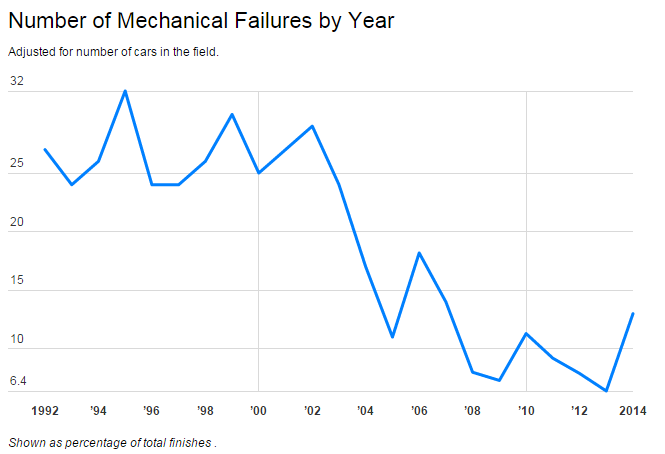
A look at mechanical failures by year shows that, in short, reliability is improving overall as time goes by.  The numbers shown are percentages of mechanical failures by year, starting with 1992.  They were calculated by taking the total number of mechanical failures of a given year and dividing it by the total number of possible finishes if every car finished every race, (the total).  

Crashes, racing incidents, and disqualifications were not included because they do not have anything to do with the mechanical reliability of the car.  If a crash was caused by a brake failure or other mechanical issue, then it was included. 

Number of mechanical failures, by year.

  
As a whole, the percentage of mechanical failures is decreasing.  In 1992, there were 130 mechanical failures which is about 27% of all the finishes, an enormous amount by today’s standards.  Last year the sport saw just 27 failures, or about 6.4%.  That means that in 2014, there were 20.6% less failures than there were 23 years ago.  

By looking at the data, you can also see the spikes where unreliability drastically improved or decreased.

 2002 to 2004 specifically saw a large drop in mechanical failures.  It went from 29% to 17%, a drop of 12 points, in those years.  The reason?

Parc Ferme.

This rule was introduced at the start of the 2003 season and limited the work teams could do on the cars after qualifying started.  Prior to the rule being implemented, teams could have a qualifying and a race setup ready to go on the car.  Once qualifying was over (where setups built for speed would be used), race setups would go on (built for longer stints, better tire wear, ect.).  

Parc Ferme stopped this practice and limited the teams to performing very minor adjustments such as changing the tires and small setup tweaks.  With teams having to focus all weekend on one setup for qualifying and the race, reliability improved. 

They had all their attention working on one car for the race, not diverted to multiple setups, and reliability benefited greatly the next two years as teams came to grip with the new rule. The percentage of mechanical failures has never come close to the 29% it was at pre-Parc Ferme rule, an attribution to its success in that department.

Kimi Raikkonen pulls into Parc Ferme after qualifying.
Kimi Raikkonen pulls into Parc Ferme after qualifying. — Photo: Mirror UK

Another time that we saw a big change was 2005-2006.  This was when the FIA and Formula One decided to switch from V10 to V8 engines to limit the increasing engine power levels.  With the new engine in place, teams had to do some major re-modifications to their cars.  

Along with those changes came changes in reliability.  Failures rose from 11% to 18.2% for the 2006 season, a 7.2 point increase.  This was a significant rule change and teams were not as successful at implementing them as they had been previously with the V10’s.

2014 saw a plethora of new changes to the rule books.  Just like 05′-06′, these adaptations saw an effect on the performance of the cars.  High up on the laundry list of adaptations was the engine switch, this time from V8’s down to V6’s.  

There was a 6.6 point increase in the number of mechanical failures from the prior year, climbing up to 13%.  The engine wasn’t the only contributing factor, though, new aero regulations, tire weight, and the switch from KERS to ERS all no doubt had an impact.

2015, however, doesn’t have many changes from 2014 in terms of rules and car specifications that need to be met.  This should mean that reliability rates increase (lower in percentage) for the 2015 season.