How Many Cautions Will We See at the Indy 500 This Year?

Since 1996, there have been an average of 8.1 cautions per race at the Indianapolis 500. As far back as my data goes to 1979, there has never been an Indy 500 without a caution and I would bet there hasn’t been as long as the race has been around.

It comes with the speed, length, and number of cars on the track. With 33 drivers racing at over 220 mph for 500 miles, cautions are bound to happen. But how many?

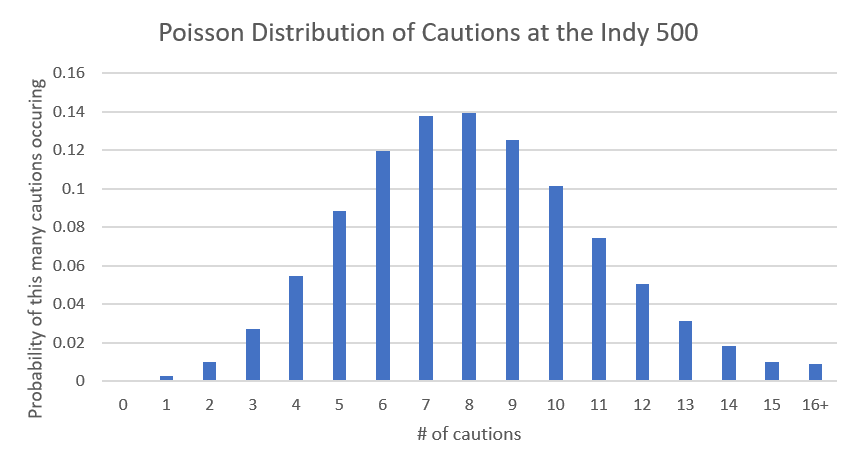
Using data since 1996, I created what is known as a Poisson Distribution for the expected number of cautions for an Indy 500 race. This distribution gives the probability of a set number of cautions occurring during the race. Here’s what it tells us:

There is a 14% chance we will see eight cautions at this year’s race, the most of any single number of cautions. Seven cautions is the second most likely outcome followed by nine.

The distribution also shows there’s a 42% chance more than eight caution flags will wave and a 19.2% chance there will be more than ten.

For all of the green flag enthusiasts out there, I have bad news for you. With a percentage chance of just 0.031%, it’s very unlikely there will be an all green race this Sunday.

Follow The Single Seater on Twitter!

Photo courtesy of Joe Skibinski/IndyCar


by Drew

Quick Notes From Indy 500 Qualifying

Ed Carpenter put his car on pole yesterday after running a blistering 230.088 mph lap one. He was the only driver to break 230 and you could hear it in the crowd’s reaction as his speed was put up on the screens around the track. The roar that erupted from an insanely fast lap is what May is all about.

The track was quick for other drivers yesterday too. Seven of the nine drivers in the Fast Nine improved on their speeds from yesterday and on average they improved 0.39 mph. That is a big difference off of Saturday and it shows how the track just got quicker as the day went on along with some improvements to the cars themselves. Castroneves, the driver I thought had the best chance to win pole position, slipped down to eighth position on the grid.

After his run Castroneves said his car was the Penske car chosen to run with the least downforce, and it hurt him in qualifying as he was unable to drive it through the corners. All Penske drivers ran a slightly different setup in qualifying so as to not put all of their eggs in one basket, and as Castroneves described it, he drew the short end of the stick. Expect him to be fast next week as they iron out a race setup.

The confidence intervals I wrote about yesterday didn’t capture the speeds we saw all that well. This is because I didn’t account for the changing track conditions on Sunday and how the racetrack was quicker the second day. I should have added an adjustment after the 10-33 qualifying session for the 0.1-0.3 mph increase we were seeing for most drivers. If this had been done, eight of the nine drivers in the top qualifying session would have had their true speeds captured in the confidence interval as opposed to just two of nine. Carpenter’s especially large confidence interval which I discussed in the article linked above did point to his big potential upside, and it showed on Sunday as he had the fastest car.

On average, the confidence intervals were off by .24 mph. I’ll be sure to keep in mind this adjustment for track speed in the future so the intervals are more accurate! Single Seater is always looking to improve and this will be just one way we will do so.

Practice will resume today for the Indy 500 at 12:30. Happy race week!

Follow The Single Seater on Twitter!

Photo courtesy of Mike Harding/IndyCar


by Drew

What We Can Learn Through Four Practices at Indy

Half of the practices drivers will get before the 102nd running of the Indianapolis 500 are now complete. With four practices down, we can start to get a good look at which drivers are looking fast this May as well as which manufacturer has the upper edge around the 2.5 mile oval. 
Marco Andretti has been the most consistently fast driver of the week, finishing in the top five in speed in all four of the practice sessions so far. He is the only driver to do this and also holds the fastest lap recorded so far with a 227.053 mph lap in the third practice session. This lap speed is 0.7 mph faster than the second fastest driver so far, Scott Dixon. 
Andretti’s Honda was the first of what would become two Honda drivers at the top of different practice sessions: A Chevy-powered driver finished in the top spot in the first and second practice sessions, and a Honda-powered driver did the same in the third and fourth sessions. This led me to wonder which manufacturer has had the upper hand so far at Indy. 
For the purposes of this article, I chose to look at top to bottom speed for each manufacturer, meaning I included every driver’s top speed so long as they met the minimum 215 mph lap speed in the given practice session. I could have chosen to look at just the top five or ten drivers for each manufacturer, but in order to gain a holistic view of the field at this year’s 500, I looked at all 35 drivers who will attempt to qualify for the race
In order to see which manufacturer has the upper hand, I found the average top speed for all drivers in all four of the practice sessions so far, separated by manufacturer. Chevy had a total average top speed of 223.323 mph for the four practice sessions and Honda had a total average top speed of 222.775 mph. This is a close gap between the manufacturers, but our analysis isn’t done yet. In order to test whether the gap between the manufacturers is significant, we can use what is called a Two-sample t-test to see what the probability is that the gap we see between Chevy and Honda is just due to random variation and chance. 
Here are the results from that analysis:
As we can see, there is just a 3.33% chance that we would see a gap at least that big between Chevy and Honda if the performance of the two manufacturers was actually equal. This means it’s very likely the gap between Chevy and Honda, taking into account all drivers, is real. Chevy has a slight advantage across the field through four practice sessions. More specifically, since the top speeds of sessions (which we used in our analysis) are almost always set using a tow (following another car in the draft), we can say that Chevy has an advantage when running in a pack over Honda. 
Friday’s practice at the speedway will be used to get teams ready for the qualifying sessions that are scheduled to take place this Saturday and Sunday. This will hopefully give us data on no-tow speeds in qualifying trim and give an idea of what we can expect for qualifying this weekend. For now we can comfortably say that Chevy has the speed over Honda when running with other cars, but that’s not to say that won’t change over the next week as teams perfect setups and get ready for the Indy 500. 

Follow The Single Seater on Twitter!

Photo courtesy of Joe Skibinski/IndyCar


by Drew

Spanish GP: Strategy Review

Hamilton cruised to victory at the Spanish GP on Sunday 20 seconds clear of his teammate in second place. The race was a fairly easy one for the championship leader, especially once Ferrari decided to bring Vettel in under safety car and put on fresh medium tires. From there on out it was a simple case of staying on the track that brought Hamilton his second win of the year. 
Vettel was the first of the leaders to pit on Lap 18, attempting to undercut Hamilton who had a 7.5 second lead on him at the time. With a pit-lane delta of about 21-23 seconds, Vettel came out 30 seconds behind Hamilton after his out lap. Over the next 5 laps, Hamilton continued to stretch his lead over Vettel, even though the former was on fresh tires. By the time Hamilton pit on Lap 25 he had close to a 33 second over Vettel and would end up coming out of the pits with fresh medium tires 12.5 seconds in front of Vettel. 
Hamilton’s tire management during the first stint while he was on the softs was spectacular as he was able to pull out a lead on Vettel even once he had pit. It allowed the Mercedes car to go seven additional laps past what Vettel did on softs comfortably. This made his second and final stint, 40 laps on the mediums, relatively easy for Hamilton. 
Besides the difference in pit-stop laps between the primary contenders, the first stint strategy was what we had expected for this race. The interesting strategy component of the race came on Lap 41 when a virtual safety car was deployed. While Hamilton, Bottas, and Verstappen all stayed out, Vettel decided to pit from second place while the virtual safety car was out. He put on fresh medium tires, but because of a very slow 5.6 second stop from his team, he came out behind both Bottas and Verstappen. Had he had a good stop, he would have come out about one second in front of Verstappen but still behind Bottas. 
For the rest of the race, Vettel struggled to make up any time on Verstappen while Hamilton continued to pull away from the field. Vettel finished just off of the podium in fourth. 
Now, let’s break down the decision to pit Vettel under the virtual safety car.
If Vettel didn’t pit under the virtual safety car, he would have had to stretch his first set of medium tires 48 laps, which is right at the edge of how long the data indicated the mediums could go. Both Bottas and Verstappen would have had slightly fresher tires (2 and 17 laps) and be about 5 and 12 seconds back, respectively. The fact that the two guys behind him had fresher tires could have partially played into the decision to pit as well, especially if Ferrari had any thought that the other teams would need to pit as well.
What’s interesting is that Bottas had tires with 15 more laps on them than Verstappen at the end of the race and was only losing around two tenths a lap in the closing part of the race. This leads us to believe that had Vettel stayed out, he would had a good shot at holding off Bottas and a near lock on third place even if Bottas got by him. 
But this assumes Vettel’s tire wear would be similar to that of Bottas’, which it wasn’t. After the race Vettel said, “we were going quicker through the tires today” than other teams, so it’s unlikely the one stop strategy would have worked for Ferrari. The two stop strategy employed for Vettel on Sunday was necessary to get him to the finish. If he had more speed on the medium tires, he might have been better able to track down Verstappen for a podium finish at the end. 

While initially a head-scratcher during the race, after breaking down Ferrari’s strategy, it appears they made the right call by bringing Vettel in. If he and the team knew the tires weren’t working well for them at Spain, it was preventative to bring him in and get fresh tires for the rest of the race, especially under the virtual safety car when his loss of track position would be minimized. Leaving him out on tires that weren’t aging well could have put him at risk for a puncture or very poor traction at the end of the race, causing him to slip even further down the grid. 

What is the Indy 500’s Rookie Orientation Program?

Every driver who competes in the Indy 500 for the first time has to complete the speedway’s Rookie Orientation Program before being allowed to test the rest of the month and eventually qualify. The program is meant to get new drivers up to speed at Indianapolis’ 2.5 mile oval and show they can run laps safely and consistently before they are sent out with other drivers.

The program has three phases.

First, the driver has to run 10 laps in a range of 205-210 mph, followed by 15 laps at the 210-215 mph range. The final phase is 15 laps at 215+ mph.

The Rookie Orientation Program for this year’s Indy 500 will take place May 15th from 1-3 p.m. for Claman De Melo who has not already completed it. Wickens, Leist, and Kaiser completed the program earlier in the month.

Follow The Single Seater on Twitter!

Photo courtesy of Chris Owens/IndyCar


by Drew