Monza Engineering Guide

Fernando Alonso leads the pack around Monza, Italy. — Photo Credit: F1 Site

Formula One heads to Italy this weekend for the fastest race of the season. Teams need low downforce and high engine power to win. Let’s take a look at the Engineering Guide for Monza, the 12th round of the 2015 Formula One season.

Full Throttle Percentage: 76%
Distance: 3.6 miles
Laps: 53

Monza is all about high speed and low downforce for almost the entire lap. 76 percent of the lap is run under full throttle, benefiting the teams with Mercedes powered engines. The track starts with a 638m run from grid to turn one where teams have to navigate a tricky chicane. The cars then head around the bend, through another small chicane, and end up at the two Lesmos. These two turns are some of the trickiest, with teams running low downforce setups, it’s easy to run off if the car doesn’t have enough mechanical grip. After the rundown to Ascari, the track ends in Parabolica – a large hairpin turn that opens up onto the DRS enabled front straight.


The setup for this track is focused on getting the highest top speed you can while still keeping enough grip for the Lesmos. Front and rear wings will be low profile with less wing in them then we see at most tracks. Several teams will be introducing new wings entirely for this weekend. Even though teams will want as tight an aero package as possible, they still need to allow for proper brake ventilation. The stress on the brakes from going over 200 mph down to first gear lap after lap can cause brakes and engines to overheat. If drivers don’t manage the heat buildup, they could have a failure on track


This track has Mercedes written all over it. Rosberg and Hamilton battled it out for the victory last year and personally I don’t see how that would change this year. Their superior power unit and aero package has showed no real signs of slowing down. Lotus and Grosjean should have another good outing this weekend, and Sebastien Vettel may also be able to provide some early challenge to Mercedes. The Ferrari team introduced a new wing in Belgium that they will likely use again in Italy. The new wing design has one less flap than the previous design and is catered toward low downforce. 


Let me know who you think will win in the comments below. I’d love to hear!

Have a #TechF1 question? Tweet it to me @thesingleseater or let me know in the comments below!


Sonoma Raceway Engineering Guide

Scott Dixon rolls through the Turn 9 Chicane during the GoPro Grand Prix of Sonoma at Sonoma Raceway — Photo Credit: John Cote

IndyCar heads to Sonoma for the season finale this weekend with six drivers still eligible for the championship. Let’s take a look at the Engineering Guide for Sonoma Raceway in California.

Surface: Road Course
Distance: 2.385 miles
Laps: 85

Sonoma is IndyCar’s tenth road/street course of the season, and also one of the toughest. The track features very short straights (one is made out of the drag strip located at the circuit), an esses section, and a brake heavy hairpin that leads on to a curvy front stretch. Besides navigating a rolling start with other cars around them on a narrow front straight, drivers also need to be ready for the heavy braking section heading into turn 2. The steep turn coupled with the braking can upset the balance of the car and send drivers running wide in qualifying and at the start of the race. 


The things teams will need to focus on this weekend are downforce through the high speed corners and acceleration rather than top speed. Cars don’t really get a good chance to top out going around this track, but getting up to speed on the slightly longer straights is imperative. Through the esses, maintaining momentum can really help you close up on a car that is struggling through the section. The hairpin like corners of 4 and 6 will provide some good overtaking opportunities in addition to the “classic” hairpin that is turn 11. A poor run out of the final turn will make you a sitting duck to cars behind on the front straight.


Sonoma is unlike almost any of the other road courses this series competes on. It doesn’t have a trademark long straight like we see in Long Beach or St. Petersburg. Therefore, it’s going to require a setup unlike any of the other tracks. Chevy have won six of the nine road/street course races this year, and they seem to have the upper hand heading into Sonoma as well. Their aero kit has been the winner most of the season despite Honda’s recent push in winning two of the last five road course races. 

However, some of the reasons for Honda’s slower pace could be because of higher downforce levels on the stock aero kit setup. Their front wing element has always had downforce in mind, with three flap elements and two endplates holding two more flaps. This has slowed them down on the straights but will benefit them in the turns. Also, if you look at their rear pod (pictured in red below), you can see the curved bottom edge that serves as a diffuser for the car. It sucks the air out from beneath the car, lowering the air pressure and therefore increasing downforce without adding any additional drag. 


Chevy opted for an angle parallel (no curve up) to the ground which makes their diffuser less effective. I don’t know if it will allow them to outrace the Chevy’s and win, but it could certainly help make them more competitive on a track where mid to high speed corners are plenty.


Update: 8/29 – If you have any more questions about the cars or Sonoma Raceway (or IndyCar engineering in general), let me know in the comments below and I’ll do my best to answer!

Race Notes: Grand Prix of St. Petersburg

The 2015 IndyCar season gets rolling in St. Petersburg for the fifth year in a row on Sunday.

Photo: Chris Owens

Will Power won the event last year to jump start his championship-winning campaign and will be looking for more of the same this time around.

Schedule: 

  • Qualifying: Saturday, 4:15 p.m. ET
  • Race: Sunday, 3:30 p.m. ET

Aero kits will make their first race appearance at St. Pete on Sunday. From the early practice sessions and pre-season testing, it looks as if Chevy have the early advantage when it comes to speed. Through session one, the top five spots in terms of lap time were all occupied by Chevy. Team Penske was the largest team contributing to that number. Will Power, Juan Pablo Montoya, and Helio Castroneves claimed the top three spots.

Times were also looking impressive early on Friday. Power’s fastest lap speed was 105.415 mph. That’s faster than every year’s pole-speed at St. Pete except 2012 and 2013. Times like this are a good sign early on in the season and development process of aero kits. Expect the top runners to beat the previous years’ pole speed on Saturday. 

Penske has traditionally had good success at St. Pete, and there’s no signs of that changing just yet. Of the ten races run at the circuit since 2005, a Penske driver has won the race five times. Castroneves leads the charge with three race wins, his most recent was in 2012.

There should be a fair number of challenges for the lead on Sunday (if history is anything to go by). The past three races have seen a combined 20 lead changes. However, it’s important to note that none of the races mentioned were run with cars using aero kits. The Chevy v. Honda battle will play a large role in how the competition pans out throughout race weekend.

Keep an eye out for qualifying on Saturday to see where the manufacturers truly stack up after testing and practice sessions for St. Pete. But even if your favorite driver doesn’t get pole position, don’t be too discouraged. Only two drivers have won the race from pole since 2005; Graham Rahal and Dan Wheldon both won the race after starting from P9. 

Weather Forecast 
Sunday’s forecast is high 60’s to 70’s and “a little breezy.” Perfect racing weather. Race weekend forecasts, provided by RaceCast Weather, will be featured in each of Single Seater’s race notes throughout the season. For more information about the forecasting process, you can view our interview with Doug Schneider of RaceCast Weather here


Off The Track
Rumors have been brewing about a possible IndyCar race in Boston. If it materialized, it would be one of the few races on the east coast and would serve as a nice replacement for Baltimore which ran 2011-2013. Do you like the idea of a Boston race? Would you attend it? Let us know in the comments below.

Live Blog
Single Seater will be trying something new for the race. In addition to our race notes, we will host a live blog for the race itself. This won’t be your average, generic live blog, though. At Single Seater, we are devoted to data journalism and statistics, and that’s exactly what our live blog will be like. 


Instead of just highlighting what’s going on in the race, our live blog will talk about statistics, race strategy, and other interesting topics surrounding the race. 

It’ll be fun. Join us here on Sunday at 3 p.m. ET when the race starts as we talk about the numbers, data, and stats behind the 2015 IndyCar season opener. 

Current Points Standings 


Is Reliability Really Improving in F1?

Felipe Massa crashed his Williams machine during the 2014 German GP.
Felipe Massa crashed his Williams machine during the 2014 German GP. — Photo: Reuters

Mechanical reliability in Formula One is always a struggle for teams each year.  FIA, the governing body of the sport, reworks and changes the rules for the teams to follow each year.

Just going from the 2013 to 2014 season alone, there were huge changes to the rule books concerning the cars. The switch from V8 to V6 engines, decrease in fuel allotment down to 100kg, and fixed ratio gearboxes were just a few of the aspects of the sport that the FIA decided to change.  Whether these changes are good or bad, that depends on who you’re asking.

Nevertheless, the teams have to conform to them and update next year’s car based on them. With that, you get uncertainty in the performance of the car due to the limited testing sessions in the Formula One off-season.  There are only a few opportunities for teams to test out the changes they have made before they have to get the cars to the grid at Melbourne for the season to start.

But are teams getting any more reliable than they were in the early 90’s?  Are they able to adapt better, quicker, and use the testing sessions early on in the season more efficiently to eliminate mechanical failures?

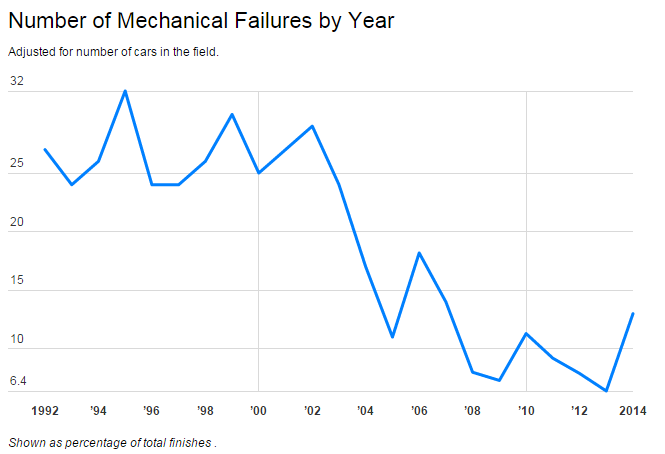
A look at mechanical failures by year shows that, in short, reliability is improving overall as time goes by.  The numbers shown are percentages of mechanical failures by year, starting with 1992.  They were calculated by taking the total number of mechanical failures of a given year and dividing it by the total number of possible finishes if every car finished every race, (the total).  

Crashes, racing incidents, and disqualifications were not included because they do not have anything to do with the mechanical reliability of the car.  If a crash was caused by a brake failure or other mechanical issue, then it was included. 

Number of mechanical failures, by year.

  
As a whole, the percentage of mechanical failures is decreasing.  In 1992, there were 130 mechanical failures which is about 27% of all the finishes, an enormous amount by today’s standards.  Last year the sport saw just 27 failures, or about 6.4%.  That means that in 2014, there were 20.6% less failures than there were 23 years ago.  

By looking at the data, you can also see the spikes where unreliability drastically improved or decreased.

 2002 to 2004 specifically saw a large drop in mechanical failures.  It went from 29% to 17%, a drop of 12 points, in those years.  The reason?

Parc Ferme.

This rule was introduced at the start of the 2003 season and limited the work teams could do on the cars after qualifying started.  Prior to the rule being implemented, teams could have a qualifying and a race setup ready to go on the car.  Once qualifying was over (where setups built for speed would be used), race setups would go on (built for longer stints, better tire wear, ect.).  

Parc Ferme stopped this practice and limited the teams to performing very minor adjustments such as changing the tires and small setup tweaks.  With teams having to focus all weekend on one setup for qualifying and the race, reliability improved. 

They had all their attention working on one car for the race, not diverted to multiple setups, and reliability benefited greatly the next two years as teams came to grip with the new rule. The percentage of mechanical failures has never come close to the 29% it was at pre-Parc Ferme rule, an attribution to its success in that department.

Kimi Raikkonen pulls into Parc Ferme after qualifying.
Kimi Raikkonen pulls into Parc Ferme after qualifying. — Photo: Mirror UK

Another time that we saw a big change was 2005-2006.  This was when the FIA and Formula One decided to switch from V10 to V8 engines to limit the increasing engine power levels.  With the new engine in place, teams had to do some major re-modifications to their cars.  

Along with those changes came changes in reliability.  Failures rose from 11% to 18.2% for the 2006 season, a 7.2 point increase.  This was a significant rule change and teams were not as successful at implementing them as they had been previously with the V10’s.

2014 saw a plethora of new changes to the rule books.  Just like 05′-06′, these adaptations saw an effect on the performance of the cars.  High up on the laundry list of adaptations was the engine switch, this time from V8’s down to V6’s.  

There was a 6.6 point increase in the number of mechanical failures from the prior year, climbing up to 13%.  The engine wasn’t the only contributing factor, though, new aero regulations, tire weight, and the switch from KERS to ERS all no doubt had an impact.

2015, however, doesn’t have many changes from 2014 in terms of rules and car specifications that need to be met.  This should mean that reliability rates increase (lower in percentage) for the 2015 season.