Predicting The Weather For Race Day

Interview

Photo: Chris Owens

The sudden unexpected rain storm or a hotter than expected day can ruin a race weekend for a team instantly. Whether they get the setup wrong or are just caught off guard, they need to be prepared and know what’s coming. We talked to Doug Schneider (a meteorologist), to get the low down on forecasting weather for a race weekend.

Doug has “had a fascination with meteorology for nearly as long as [he] can remember.” After being inspired by Hurricane David in 1979, he knew he was either going to be a race car driver, or a meteorologist. “Lacking the budget for racing, I chose the latter,” he added. From there, Doug attended North Carolina State University, where he earned both a Bachelor’s and Master’s degree in meteorology. Doug has been working as a forecaster for 15 years now and lives in Tennessee.


How did you start forecasting IndyCar races?


The idea started when I discovered Brian Neudorff on Twitter. He’s a TV meteorologist who also makes unofficial forecasts for NASCAR races. My favorite racing series are TUDOR United SportsCar and IndyCar, and I always looked at the weather forecast for each race weekend anyway, so I figured why not make my own forecasts geared toward fans of those series? It’s been fun combining my two passions of weather and racing.

But once I started, it didn’t take long for me to realize I needed some help. It can get busy keeping up with live weather updates, and my work and family schedule didn’t always cooperate. So I approached a fellow weather geek and race fan, Scott Martin, to be my partner. He’s currently a meteorology student at Mississippi State University. He has experience in graphic design too, and he created the great-looking forecast graphics and logo that we use. He’s been a great help to me, and does a great job.

How do you go about making race weekend forecasts?

The first step is to make a cup of strong coffee – freshly-ground organic beans, steeped in a french press. Then I evaluate various computer model projections. These models take in observed weather data from around the world, then use mathematical equations to simulate how the atmosphere will change over time. As computing power has increased, the programmers have made major strides in model accuracy over the past several decades, but they’re not perfect, and I still have to evaluate and interpret what the different models are telling me based on my own experience. I have access to a wealth of data at my work, but tons of data are also available on the web.

The two most important questions to answer to determine if it will rain are:

  • Will there be enough moisture in the atmosphere?
  • Will there be a way to lift the air upward?

These are the two basic ingredients needed to produce rain, but the tricky part is to figure out the balance of the two, and the timing of when they come together. After I create my own forecast, I’ll look at the forecast discussion from the local National Weather Service office that covers the race track area to see if their thoughts jive with mine, as they have the local expertise that I don’t have. As we get closer to race day, I’ll use radar and satellite data to give a more precise forecast of the timing of rain, and which race events might be impacted.
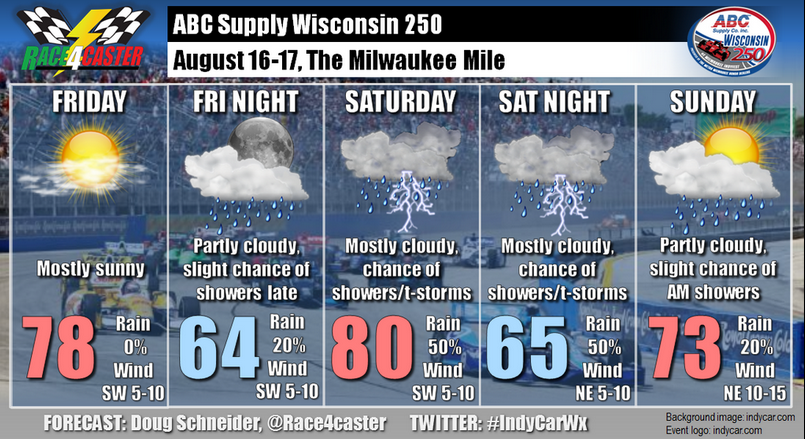
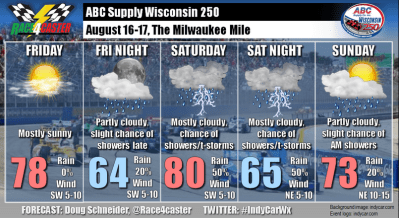
Doug and Scott’s forecast for the 2014 Milwaukee race.

What’s the toughest part of making accurate predictions?

It’s difficult to admit that sometimes I have very little confidence about what is going to happen. Meteorology is an inexact science. Weather works in three dimensions – we need to figure out not only what is going on at the ground, but also up through eight miles into the atmosphere, all around the globe. We don’t have 100% knowledge of what’s going on in the atmosphere 100% of the time. We have to make estimations and assumptions to fill in the gaps.

As a result, there are times when the various computer models can all show something completely different happening. But I have to make a forecast anyway, and I have to take responsibility for it. I put my name on all my forecasts, and I don’t hide behind a pseudonym.

Fortunately, people have been kind enough so far not to point out when I’m wrong, but I have to use those times as a learning experience to improve my forecasts in the future. It’s tough to tell people that I don’t have confidence about what’s going to happen, but I have to be honest and realistic about my limitations.

How important are these forecasts to a team on a race-weekend?

I can’t say for certain how race teams use a weather forecast in their strategy, so I can only speculate a few ways it might be helpful.

Knowing if temperatures will be hot over the weekend could help teams be better prepared to keep their drivers and crew members cool and hydrated. Hot or cold temperatures could also affect the setup of the car. If rain is expected to arrive during the race, teams could adjust their pit strategy in advance to gain an advantage.

I would think that the forecast would be very important to Firestone, as they would need to estimate how many sets of rain tires might be needed over the weekend. Track organizers and local medical/emergency crews need to stay aware of the weather for the safety of the fans in attendance, such as preparing for extreme heat or knowing when to evacuate the grandstands as a thunderstorm approaches.

Is there anything else you would like to add?

I started doing race forecasts in January, and I’m amazed at how quickly it has grown. I really appreciate all the follows and retweets, as well as any feedback on the forecasts. If anyone has a weather question, racing-related or not, I’m always happy to answer the best I can.


Where can people find you?

I post my forecast updates and live weather updates during races at my Twitter account, @Race4caster. Be sure to also follow my partner Scott at @RaceWx4You, as he’ll be forecasting for the Sonoma and Fontana races.

Both of us always mark our forecasts with the hashtag #IndyCarWx so they’re easy to find if you miss our posts. Our TUSC forecasts can be found at #TUSCwx, and our Pirelli World Challenge forecasts at #PWCwx. We don’t yet have a website for posting our IndyCar forecasts, but our TUSC and PWC forecasts are posted at NASportscar.com.


—-

Forecasting the weather for race day isn’t easy (as you can see), but it’s necessary for the teams and track to have a good idea of what’s going to happen. If you have any more questions, let us know in the comments below or on Twitter.

Milwaukee Mile: Race Notes


Three races remain in the 2014 IndyCar season, that’s it.  The first comes this weekend in Milwaukee, the next in Sonoma, California, and the final is the double points finale race in Fontana, California. 


Schedule:
  • Qualifying: 6 p.m 8/16 EDT
  • Race 3:45 p.m. 8/17 EDT
Going into these championship deciding races Will Power holds the championship lead by just four points.  This is one of the tightest the standings have been all season.  Power took over the points lead last week in Mid Ohio after a sixth place finish, hardly a great performance after starting in the same spot.  But what really gave Power the edge was just how poorly Castroneves finished, down in 19th place and only scoring 11 points.  

That 19th place finish was Castroneves’ second worst of the season (his worst came in the second race in Houston with a 21st place finish), and ultimately cost him the championship lead.  

With the season heading to Milwaukee, all eyes will be on the driver third in the points, Ryan Hunter-Reay.  Hunter-Reay won at the mile the last two years, and in pretty commanding fashion as well.  His average margin of victory for his wins was 4.91 seconds, certainly not anything to frown upon.  The only races that had a victory gap that large this year were race two of Houston (7.26 sec.) and Mid-Ohio (5.39 sec.).  

If Ryan Hunter-Reay wins this weekends race, as expected, he would be able to gain a max of 54 points.  Even with a great result such as that, he would still be too far out (Hunter-Reay is currently 63 points behind Power) to claim the lead this weekend.

If we take a look at Power and Castroneves, the latter historically has the upper hand at this track, but only slightly.  Castroneves has out raced Power two out of the last three times at the track and never failed to finish outside the top ten (Power has on one occasion).  

The championship standings could swing quite a large margin this race, so we’ll take a look at how the points could play out here:
  • If Will Power finishes the race in front of Helio Castroneves, he will retain his points lead.  Power will also gain at least a 15 point lead on Castroneves if he wins the race. This is due to his current four point lead, the 10 point difference between first and second, and one point for leading a lap (the final one at least).  Power would gain a bigger lead if he wins pole, leads the most laps or Castroneves finishes worse.  
  • If Helio Castroneves finishes the race in second or better and above Power, he will take the championship lead.  If Castroneves finishes second with Power in third, he would have a one point lead.  Of course, this would all change depending on if Power led the most laps, led a lap, or won pole position.  
  • If Ryan Hunter-Reay wins the race, he won’t be able to take championship lead, no matter what.  He is too far back in the standings (63 points back from Power) to make up the points all in one race.  However, if he does win he’ll put himself in a good position for the final two races.  
  • Obviously, these are not all of the possible race scenarios and outcomes.  We’ll be tweeting out updated points standings throughout the race.  For as-they-run points updates during the IndyFest, follow Single Seater on Twitter here.  
The forecast for this weekend’s IndyFest.
IndyCar Features:

The Battle For The #1 Driver Spot

Mercedes drivers Nico Rosberg and Lewis Hamilton at the Malaysian Grand Prix.  Source: mirror.co.uk

The battle between teammates on a Formula 1 team is one of the best ways to see how a driver is stacking up in his car.  With the same car and performance, it’s really up to the driver to prove himself against his teammate.  With the season on break right now, it’s a good time to see how the inter-team battles are going within all eleven constructor’s.  


Mercedes 
The silver arrows have been on top of things this year, winning nine out of the eleven races this year and leading the constructor’s championship by a landslide.  Both Hamilton and Rosberg have had great seasons with five and four wins, respectively.  Even with Hamilton’s extra win, he still ends up in second place in the championship down by 11 points.  

We give Rosberg the decision here as the leading driver, he has out qualified Hamilton 60% of the time as well as spent a few more laps ahead (53.7% of the time).  Without Hamilton’s two qualifying mishaps, the decision could have very well gone to him.  Rosberg has seemed to be the qualifier to beat, while Hamilton has the race pace to bring home the wins.  We’re picking Hamilton to bring home the championship barring any qualifying or reliability issues in the next half of the season.  


Red Bull
RB Racing hasn’t been enjoying the same success it endured last year with Sebastien Vettel taking home the driver’s championship.  In fact, Vettel is on pace for his worst season in the last four years if his form continues.  The saving grace for the world champs has been the new addition to the team, Daniel Ricciardo.  

Ricciardo has put up two wins so far this season as well as qualified ahead around 63% of the time.  He hasn’t put up any pole positions yet and we don’t expect him to either, this year. Daniel has been thoroughly outperforming his four time world championship teammate in the first half of the season.  


Ferrari
Over at the Italian team, the leader has been pretty clear, Fernando Alonso.  The addition of world champion Kimi Raikkonen hasn’t done much at all to throw off Alonso, he’s averaging a 4.9 finish and holds 115 points and fourth place in the driver’s championship

Kimi has yet to come out of a race ahead of Alonso, or even secure a podium finish.  With the world champion set to have a child and retire once his contract with Ferrari is up, just getting a top five finish would be a good accomplishment.  


Williams
Williams F1 has seen a comeback to their old success this season, they are fourth in the constructor’s championship just behind powerhouse Ferrari.  The majority of this success has come from second year driver Valtteri Bottas.  Bottas has gotten great performance out of the Williams machine this year, putting up three podiums and 95 points.  His average finish is 6.5 as well, improved from 14.4 last year.  Bottas has definitely been one of the drivers in contention for podiums this year. 

His teammate, Felipe Massa, hasn’t been bad either this season, however.  He has a pole position under his belt but has been plagued by failures in the races.  Massa has 40 points this year as well as three accidents in races (the most of any driver this season).  If he can tighten up and get a reliable car, he’ll be competitive in the remaining races.  


Force India
Force India is enduring a pretty good season so far themselves, fifth in the championship thanks to drivers Sergio Perez and Nico Hulkenberg.  The latter has been the real force in the team, securing the lead in the major categories of teammate grading (qualification, finish position, and points).  

Hulkenberg has 69 points and is seventh in the championship, ahead of where he finished last year in tenth.  Perez, coming from McLaren last year, has put up one podium performance this year in Bahrain.  Other than that, he’s in the bottom half of the standings with 29 points.


McLaren
The mighty McLaren hasn’t been having the season it expected, down in sixth in the constructor’s with less than a 100 points.  The senior Jenson Button has been the “best” out of the two, but best isn’t even relevant here, maybe “not as bad” is better.  Button has one podium and four finishes outside the top ten.

The rookie Kevin Magnussen hasn’t been having a poor first season by any standards, though.  He managed a second place finish in Melbourne and will surely reach higher than that if he tightens up his form.  Kevin is practically split with results, five outside of the top ten and six in it.  With a more reliable car and some experience, Magnussen will be a strong competitor.  


Toro Rosso
Toro Rosso is another team that hasn’t been spectacular this year.  That being said, the stats show Jean-Eric Vergne just edges out rookie Kvyat in the battle.  JEV has 11 points this year compared to Kvyat’s 6.

It also shows that JEV hasn’t been improving that much, his average finish hasn’t moved by more than .4 for the last three years.  If both drivers stay at Toro Rosso next year, Kvyat should be able to be the number one driver above the stationary Vergne.  


Lotus
The black and gold car has been having a dismal season compared to last, largely in part to the departure of Kimi Raikkonen from the team.  Kimi scored 183 points for the team last year, this year there only up to eight.  

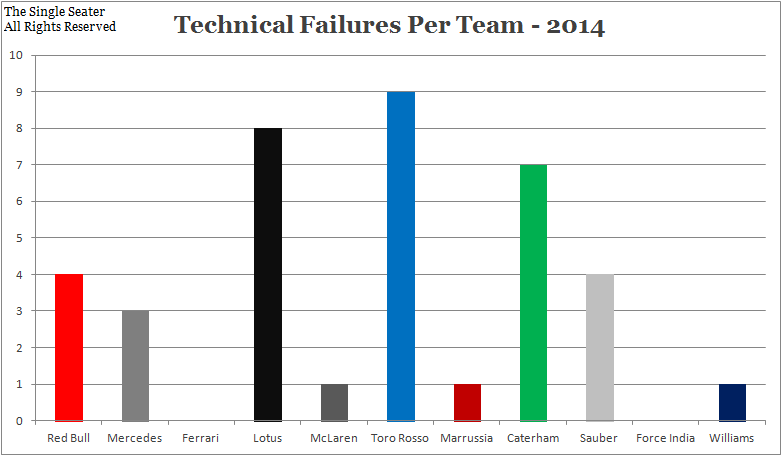
Even with the poor results, (and eight technical failures this season) Romain Grosjean is the driver to beat in the duo.  He’s scored all of the eight points for the team and finished ahead three quarters of the time.  Maldonado hasn’t done much for the team this year except get penalties, four of them.  


Marrusia
Marrusia racing have never been a particularly strong team, but Jules Bianchi has given the team something to look forward too.  Bianchi gave Marussia it’s first championship points with a ninth place finish in Monaco.  In addition to that, he’s out qualified, finished and led his teammate for often than not. 

Max Chilton is struggling the same as last year at Marrusia.  With no points yet in the season it’s looking like they won’t come at all this year.  


Sauber
Adrian Sutil has managed the best of the two Sauber drivers with the struggling car this year.  His highest finish is 11th in both Melbourne and Hungary, significantly worse than last season when he was with Force India.  He’s only completed 72.5% of the total number of laps this year, one of the lowest of any driver.  

His teammate, Esteban Gutierrez, hasn’t fared any better.  He has made it up to a 12th place finish and is the leader of penalties.  With three qualifying penalties, one drive through, and two stop-go penalties, he definitely isn’t on the stewards good side. 


Caterham
Caterham have been on the bottom of the standings for most of this season, but that hasn’t stopped veteran Kamui Kobayashi from showing his rookie teammate how it’s done.  

Kobayashi has out-qualified, raced, and led more laps than Marcus Ericsson throughout the 2014 season and shows no signs of slowing down. 

What do you think of our picks for the #1 driver on each team?  Love ’em, hate ’em?  Let us know in the comments.  

          – Drew Bennison 


The Weekly Report

Each week, we take a look at our most popular articles and stories from around the web and put them into one post. Some of them will be data based and some will be just interesting or important news stories in the racing world.  Welcome to the second installment of the Weekly Report:


Popular On Our Site


From Around The Web

Note: If you have an article you think should make it into the Weekly Report next week, let us know by sending it in through the form on the contact page. We’ll take a look at it and perhaps put it in next weeks edition! 

Also This Week

The Single Seater now has a Facebook page which you can like and follow here!  Remember to share the page and stay up to date with news about the site, as well as stats, graphs and more. 

The Leaders

IndyCar – Will Power – 548 Points

Formula 1 – Nico Rosberg – 202 Points

          – Drew Bennison


Mid-Ohio: Race Notes

The start of the 2012 race at Mid-Ohio.

With only four races left in the 2014 season, IndyCar heads to Mid-Ohio with Helio Castroneves in the lead.  Castroneves has 533 points and a 13 point lead on second place driver Will Power.  Mid-Ohio has the best chance of changing up the championship battle, as Castroneves has an average finish of ninth over the last three years at this track. Respectable, but it may not be enough to fend off Will Power.

Schedule:

  • Qualifying: 2 p.m. 8/2 EDT
  •  Race: 3:50 p.m. 8/3 EDT

The Race:
Our statistics go back to 2007, so that’s the data points we’ll be looking at.  Since then, no race has been won by a driver starting outside of the top ten.  Scott Dixon was the lowest starting-place winner (from 6th) back in 2007.  This phenomenon could be attributed to just how hard is is to pass at Mid-Ohio: 

Passing:

The average lead changes per race here is 5.4, significantly lower than other circuits on the calendar.  The track also changes with each passing lap in a race situation, according to the driver’s themselves.  In the beginning of the race the track “is such a slippery, difficult condition.” By the end of the race, there’s so much rubber down, it’s a really grippy circuit.” said IndyCar driver Takuma Sato.  If the driver’s qualify outside of the top ten, history is not going to be on their side Sunday afternoon.  

Caution Laps:

Mid Ohio, much luck Toronto was (until the rain races where we saw 20 caution laps in one race), is pretty consistent with the lack of cautions, none in the last two years and an average of 2.3 a race before that.  Green flag pit-stops have been less common than yellows this season (as expected), with most drivers having 52-65% of their pit-stops come under yellow. If the cautions don’t come out, will it benefit the driver’s who have had more green flag pit-stop practice this year?  Honestly, we have no idea.  But if it does, look for Mike Conway and Graham Rahal to be fast on pit-lane (or good with strategy), they rank among the most with green flag stops.

Kimball:
Last year Charlie Kimball took home his first win at Mid Ohio, and also his only win of the season. Since then and throughout most of this season Kimball has been pretty good but still not much of a threat to the points standings.  He ranks 13th in the driver’s standings and has a top ten percentage of 64%.  

Dixon:
Scott Dixon has also won at Mid Ohio four times, the most of any current driver in the field. Even with that success, Dixon has been having a poor season this year compared to last-one podium to six, and no wins to four last season.  There are only a few races left to turn this around with the championship coming to a close soon.  Scott Dixon runs 6th in the standings just behind IndyCar returnee Juan Pablo Montoya.  Mid Ohio has been a place of success for Dixon, so expect him to be a sleeper in the race and maybe have a chance at the win yet again.  

Who To Watch:
Will Power / Scott Dixon / Charlie Kimball / Helio Castroneves 

IndyCar Features: 


          – Drew Bennison